
DASH Diet: Food List, Sample Meal Plan and What the Research Shows
The DASH diet is an eating plan from the US National Heart, Lung, and Blood Institute (NHLBI) built on vegetables, fruit, whole grains, low-fat dairy and lean protein, with less salt, saturated fat and sugar. Below you'll find the food list with daily servings, a sample day of meals, how much sodium to aim for and what the original trials found.
What is the DASH diet? What DASH stands for
DASH stands for Dietary Approaches to Stop Hypertension. It is an eating plan published by the US National Heart, Lung, and Blood Institute (NHLBI), part of the National Institutes of Health, under the name “DASH Eating Plan.”
The DASH diet did not start as a trend. It came out of research on how food affects blood pressure. The first large DASH trial was published in 1997, and a follow-up study on salt, called DASH-Sodium, was published in 2001. Both are described in the research section below.
At heart, the DASH eating plan is not a list of forbidden foods. It is a pattern: plenty of plants, whole grains and low-fat dairy, modest amounts of lean protein, and less salt, saturated fat and sugar.
DASH diet guidelines: the main principles
The NHLBI sums up DASH in a few simple rules:
- Eat plenty of vegetables and fruit: 4 to 5 servings of each a day.
- Choose whole grains for most of your bread, cereal, rice and pasta.
- Pick fat-free or low-fat dairy, such as milk, yogurt and lower-fat cheese.
- Get protein from fish, poultry, beans, nuts and seeds, with lean meat in small amounts.
- Keep saturated fat low. The NHLBI target is about 6% of calories from saturated fat and 27% from total fat.
- Limit sweets and sugary drinks.
- Watch sodium: no more than 2,300 mg a day, with 1,500 mg as the lower goal.
- Favor potassium-rich foods such as vegetables, fruit, beans and dairy. The plan’s potassium target is 4,700 mg a day.
These nutrient targets are based on about 2,100 calories a day. The servings below are for 2,000 calories.
DASH diet food list: servings per day
This DASH diet food list follows the NHLBI plan for 2,000 calories a day.
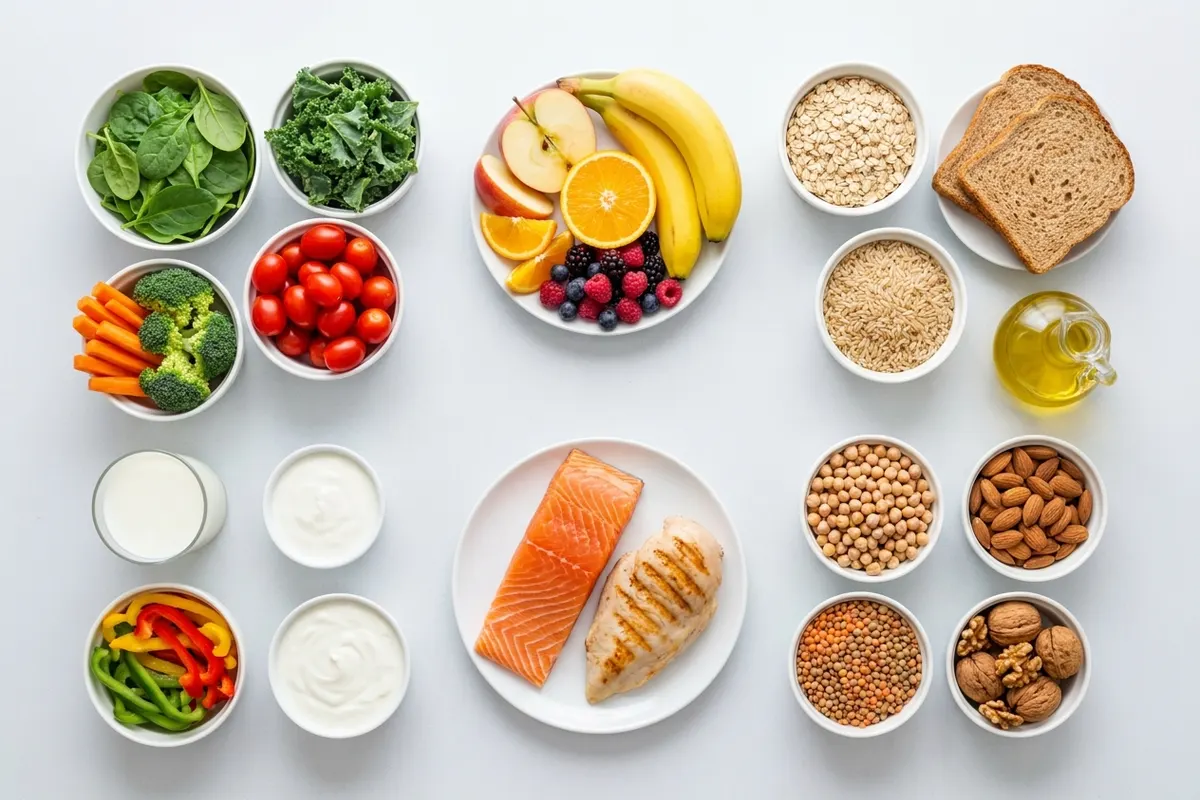
| Food group | Servings (at 2,000 kcal) | What one serving is |
|---|---|---|
| Grains (mostly whole grains) | 6–8 per day | 1 slice of bread; ½ cup (about 90 g) cooked rice or pasta |
| Vegetables | 4–5 per day | 1 cup (about 30 g) raw leafy greens; ½ cup (about 90 g) cooked vegetables |
| Fruits | 4–5 per day | 1 medium fruit, such as an apple, orange or banana |
| Fat-free or low-fat dairy | 2–3 per day | 1 cup (about 240 g) milk or yogurt; 1½ oz (about 40 g) cheese |
| Lean meat, poultry, fish | 6 or less per day | 1 oz (about 30 g) cooked, or 1 egg |
| Nuts, seeds, legumes | 4–5 per week | ⅓ cup (about 40 g) nuts; ½ cup (about 90 g) cooked beans or lentils |
| Fats and oils | 2–3 per day | 1 teaspoon (about 5 g) vegetable oil |
| Sweets and added sugars | 5 or less per week | a small portion, such as a spoonful of jam or a small scoop of sorbet |
Not everyone needs 2,000 calories. A smaller, less active person may need fewer servings of grains and fats, and a taller, more active person may need more. The NHLBI lists servings for other calorie levels; a doctor or registered dietitian can help you find yours. The balance between the food groups stays the same.
What to limit on the DASH diet
DASH is more about adding good foods than cutting things out. Still, a few foods take up most of the room in a typical American diet and leave little space for the rest:
- Sweets and sugary drinks: soda, sweet tea, candy, pastries and desserts. Keep them to 5 servings a week or fewer.
- Red and processed meat: bacon, sausage, hot dogs, deli meats and large steaks. They tend to be high in saturated fat, and processed meats are also very salty.
- Full-fat dairy: whole milk, cream, butter and many cheeses. Swap for low-fat versions.
- Salt-heavy foods: canned soups, frozen dinners, chips, pickles, pizza, fast food, and sauces such as soy sauce or ketchup.
- Fatty fried foods, which add saturated fat with little benefit.
You don’t need to give these up forever. Making them occasional, not daily, is the idea.
Salt and sodium on the DASH diet
The DASH eating plan sets a sodium limit of 2,300 mg a day. According to the NHLBI, that is about 6 g of salt, or roughly 1 teaspoon. The plan also has a lower goal of 1,500 mg of sodium a day, about 4 g of salt or two-thirds of a teaspoon.
Other health bodies point in the same direction. The World Health Organization (WHO) recommends less than 2,000 mg of sodium a day for adults, which is less than 5 g of salt. The 2024 European Society of Cardiology (ESC) guidelines suggest about 2 g of sodium a day for adults with elevated blood pressure or hypertension.
The hard part is that most salt is not the salt you add yourself. According to the American Heart Association, more than 70% of the sodium Americans eat comes from packaged, prepared and restaurant foods, not the salt shaker. Bread, cheese, deli meat, soups, sauces and takeout can add up fast, even when a meal doesn’t taste very salty.
That hidden salt is why HeyBeet was built. You take a photo of your meal and get a Heart Score from 1 to 10 that shows how well it fits DASH targets, plus one simple swap. HeyBeet does not measure sodium or replace a doctor; it helps you notice where salt hides in everyday meals.
Sample DASH diet meal plan for one day
Here is a simple DASH diet menu for one day, using familiar foods. Portions are a guide for about 2,000 calories; adjust them to your needs.
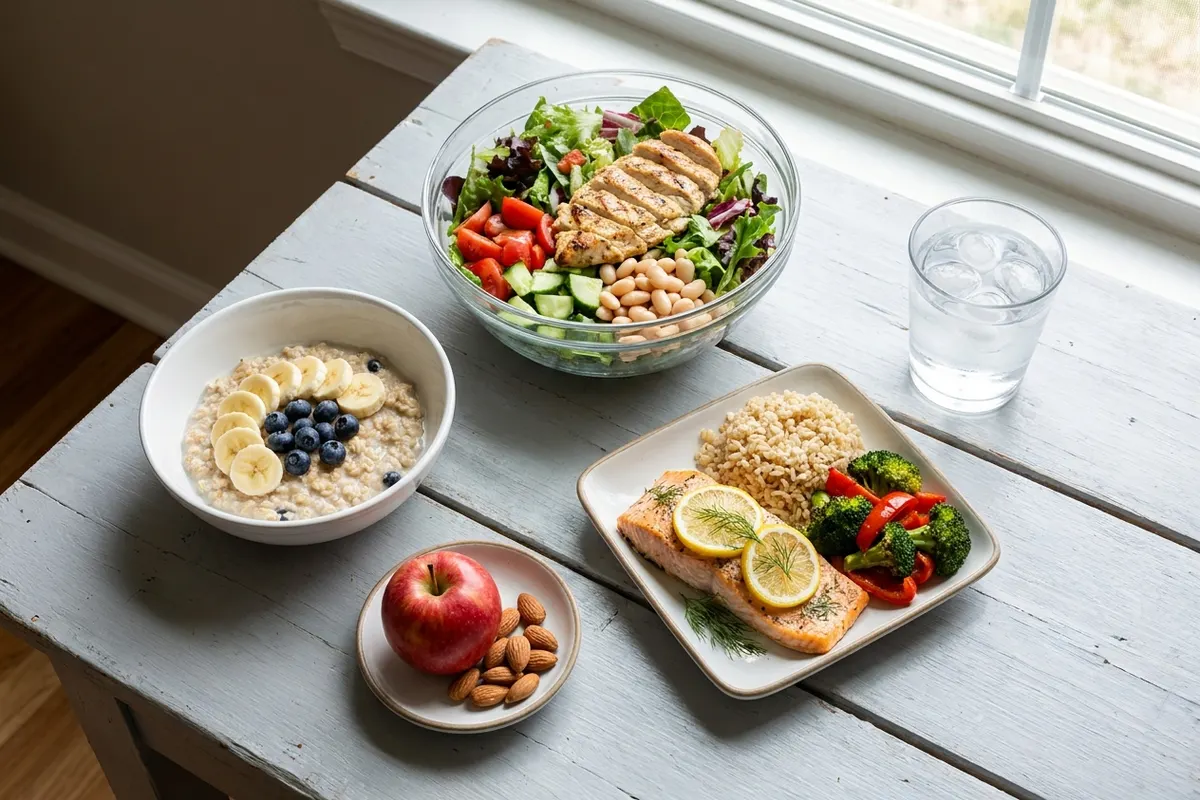
Breakfast: a bowl of oatmeal cooked with 1 cup (about 240 g) low-fat milk, topped with a sliced banana and a handful of berries.
Morning snack: 1 cup (about 240 g) plain low-fat Greek yogurt with a pinch of cinnamon.
Lunch: a large salad of leafy greens, tomatoes, cucumbers and carrots with sliced grilled chicken and ½ cup (about 90 g) rinsed canned beans, dressed with olive oil and lemon. One slice of whole-wheat bread on the side.
Afternoon snack: an apple or an orange and ⅓ cup (about 40 g) unsalted almonds. Nuts and beans count toward 4–5 servings a week, so on other days have fruit or vegetables instead.
Dinner: baked salmon with lemon and dill, ½ cup (about 90 g) brown rice, and a generous serving of roasted broccoli and bell peppers cooked in a teaspoon of oil.
This day leans on vegetables, fruit, whole grains and low-fat dairy, and keeps salty foods to a minimum. Season with herbs, garlic, pepper and lemon instead of salt.
Ideas for the week
- Monday: whole-wheat toast with peanut butter and a banana; turkey and vegetable soup made with low-sodium broth.
- Tuesday: Greek yogurt with oats and berries; chicken stir-fry with plenty of vegetables over brown rice.
- Wednesday: vegetable omelet with whole-wheat toast; bean and vegetable chili with a side salad.
- Thursday: oatmeal with apple and cinnamon; grilled salmon with sweet potato and green beans.
- Friday: fruit smoothie with low-fat milk; homemade whole-wheat pizza with vegetables and a little cheese.
- Saturday: whole-grain pancakes with fruit; chicken salad wrap in a whole-wheat tortilla.
- Sunday: scrambled eggs with spinach; roast chicken with brown rice and roasted vegetables.
What the research shows: DASH diet for high blood pressure
The original DASH trial, led by Appel and colleagues and published in the New England Journal of Medicine in 1997, followed 459 adults for 8 weeks. Sodium was held at about 3,000 mg a day, so the effect came from the food pattern, not from cutting salt. Compared with a typical American diet, systolic and diastolic blood pressure fell by 5.5 and 3.0 mmHg on average.
In the 133 participants with hypertension, the average drop was 11.4/5.5 mmHg. In those without hypertension, it was 3.5/2.1 mmHg. A diet that only added fruits and vegetables lowered systolic pressure by 2.8 mmHg, about half the effect of full DASH.
The DASH-Sodium trial, led by Sacks and colleagues and published in 2001, studied 412 adults. It tested DASH and a typical diet at different sodium levels. DASH at low sodium, compared with a typical diet at high sodium, lowered systolic blood pressure by 7.1 mmHg in people without hypertension and by 11.5 mmHg in people with hypertension. Less sodium helped on both diets, and the effects of DASH and lower sodium added up.
Keep in mind that these are average results in carefully run studies. Individual results vary, and a study result is not a promise for any one person.
Who the DASH diet suits, and who should be careful
The DASH diet uses ordinary foods, so it can work for most adults and families. It is often discussed for:
- Older adults. Interest in the DASH diet for seniors is high, because blood pressure tends to rise with age. The plan is flexible and uses foods that are easy to find and cook.
- People with high blood pressure, since the plan was designed and tested in blood pressure research.
- People with high cholesterol, because DASH is low in saturated fat.
- Anyone who wants a simple, balanced way to eat without counting every calorie.
Some people need to be careful. DASH is rich in potassium. People with kidney disease, or who take certain blood pressure medicines (for example potassium-sparing drugs), may need to limit potassium. Potassium-rich salt substitutes are not right for everyone either.
If you have a health condition or take medication, talk to your doctor before changing your diet. Never stop or change a medicine on your own, even if your readings improve. This article is general information, not medical advice.
DASH diet vs Mediterranean diet
Both are well-known healthy eating patterns, and they share a lot: plenty of vegetables, fruit, whole grains, beans and fish. The main differences are in the details.
| DASH | Mediterranean | |
|---|---|---|
| Origin | NHLBI eating plan tested in blood pressure trials | Traditional eating pattern of countries around the Mediterranean Sea |
| Structure | Clear daily and weekly servings per food group | A general pattern, without fixed servings |
| Sodium | Limit of 2,300 mg a day, lower goal 1,500 mg | No set sodium number |
| Dairy | 2–3 servings of fat-free or low-fat dairy a day | Moderate, mostly cheese and yogurt |
| Main fat | Vegetable oils in small amounts | Olive oil as the main fat |
If salt is your main concern, DASH gives you clearer numbers to work with. Many people combine the two: DASH servings and sodium limits, with olive oil and Mediterranean-style dishes.
Sources
- NHLBI: DASH Eating Plan
- Appel LJ et al. A clinical trial of the effects of dietary patterns on blood pressure. NEJM, 1997
- Sacks FM et al. Effects on blood pressure of reduced dietary sodium and the DASH diet. NEJM, 2001
- World Health Organization: Salt reduction
- American Heart Association: How much sodium should I eat per day?
- 2024 ESC Guidelines for the management of elevated blood pressure and hypertension
Frequently asked questions
What does DASH diet stand for?
DASH stands for Dietary Approaches to Stop Hypertension. It is the name of an eating plan from the US National Heart, Lung, and Blood Institute (NHLBI), first tested in research on blood pressure.
Is DASH diet safe?
For most adults the DASH eating plan is simply a balanced way of eating built on everyday foods. People with kidney disease, or who take certain blood pressure medicines such as potassium-sparing drugs, may need to limit potassium, so they should ask their doctor first.
How much sodium per day is allowed on the DASH diet?
The NHLBI plan sets a limit of 2,300 mg of sodium a day, about 1 teaspoon of salt. A lower goal of 1,500 mg, about two-thirds of a teaspoon, is also part of the plan.
Is the DASH diet good for weight loss?
DASH was designed and studied for blood pressure, not as a weight loss diet. Its foods are filling and fit any calorie level, and the NHLBI shows how to adjust servings to your calorie needs.
Where can I find DASH diet recipes?
Almost any recipe can fit DASH if it is built on vegetables, fruit, whole grains, beans, fish or poultry and is cooked with little salt. Herbs, garlic, lemon and spices add flavor in place of salt.
What is the difference between the DASH diet vs Mediterranean diet?
Both put plants, whole grains and fish first. DASH sets clear daily servings and a sodium limit and includes low-fat dairy, while the Mediterranean pattern centers on olive oil and has no set sodium number.